Showing posts with label houses. Show all posts

Friday, January 12, 2007

Alzira, empregada

Mozambique, like third-world countries in general, is characterized by low labour costs. As a result, everything is done manually. Here, for example, lines are painted on the roads by a guy with a big brush and a can of paint. The street sweeper is literally a lady holding a hand-made broom.

Because of the low labour costs, many middle- and upper-class residents of Mozambique can afford guards and cleaners for their homes. Alzira is the empregada (which translates simply as, "worker") that we inherited with our apartment to come and clean it once a week.

Alzira's husband died less than a month before we arrived, leaving her to tend her children by herself. She's only able to find work twice a week, so we decided to keep using her to provide her with much-needed income, though we appreciate the help cleaning as well.

Her wage is 140,000 meticais (about $5.75) per day, a raise of $1 over her previous employers. Combined with another part-time job that Alzira has, her weekly income is about $10. We also pay her an extra 10,000 meticais for her transportation to and from work.

We decided that if she was going to work for us, we'd like to visit her home and see how she lives, too. And once we were there, we knew that it was the right decision. The shy and reserved Alzira who avoids making eye contact in our apartment vanished. In her place was a broadly-smiling Alzira who was proud to show us her home and her children.

She lives in a simple house, the entire yard being perhaps 1,000 square feet. The main building is a brick structure where the "living" is done (mostly sleeping, really). There's also a kitchen at the front of the property, strung together with spare materials, and a hole in the backyard where she is slowly building a washroom with money that she saves.

I thought that it must be strange having a kitchen and a washroom outside the house, but learned that many Mozambicans think we're just as strange for wanting them inside. The difference is a function of several factors:

  • Most cooking is done over open fires (of wood or charcoal), or with gas for those who can afford it. Keeping the kitchen outside reduces the pollutants in the house where the family sleeps.
  • Not having to endure winter months means that "outside" and "inside" are boundaries that get blurred. Alzira's kitchen and washroom are just as close to her bedroom as are ours; the major difference is that our hallway happens to be covered by a roof, whereas hers is not.
  • A family's kitchen and bathroom are functionally operational before a structure is built around them. For instance, cooking can be done in a fire pit beside the house before the walls of a kitchen are built around it. In Africa, homes are built in phases.
And, of course, because everything is done by hand in Mozambique, Alzira conducts these construction projects on her own. Her form of savings is very typical: when she has extra money, she buys building materials. She'll continue building once she has accumulated enough material.

Friday, January 05, 2007

Homes and Cell Phones

I've been meeting with a young man named Mario twice a week to practice speaking Portuguese. I've been paying him for his services because it's truly been helpful, and because, at 24 years old, he's trying to finish school and look after his younger brother at the same time. He's looking for work as a translator at embassies, or as a chef. He loves to cook.

I met Mario at a local church that I attend more frequently than any other right now -- perhaps once every second week. He took the initiative to approach me for a job, and takes his commitment seriously.

Mario just showed me his new cell phone. It cost him $80, which I loaned him as an advance on his salary, to be paid back over two months.

The ubiquitous cell phone is a major asset in Mozambique. Just yesterday I heard about someone who is in hospital suffering stab wounds from a screwdriver. The thief coveted her cell phone.

By contrast, Mario is also paying a mortgage on the house he lives in. Because banks in Mozambique aren't interested in such small loans (and may not consider his meagre structure to be suitable for a mortgage anyway), the home's previous owner holds the mortgage (and title to the house, until Mario has completed his payments). Mario pays whenever he can put together some savings. He's not expected to pay monthly.

The house will cost roughly 20,000 meticais nova familia -- or about $800.

In other words, I just lent him 10% of the value of his house to buy a telephone. I was shocked. Surely that's an obscene amount of money for a phone.

Laura and I dropped him off at his house recently, in a subdivision of Maputo called "Polana Caniço." The house has three rooms, but it's only half-built: only one of the rooms has a roof, which consists of corrugated steel sheets set across the tops of the walls. There are holes where windows, or at least iron grates, might eventually go.

Some common features of homes in Canada are unnecessary and unheard of here. You have a heater in your home? Everybody does? Most Mozambicans don't understand the Canadian climate, and don't care to.

And other common features are luxurious. Like running water, which Mario doesn't have.

He doesn't have electricity either, because he can neither afford to hook it up nor afford to pay the bills. It's all too easy to forget the luxury that we are enjoying in Maputo: our electricity costs about $40 a month, purchased in advance on a pre-paid card. By contrast, the minimum wage in Mozambique, for those fortunate enough to have full employment, is US$58 a month.

(And even still, I don't know how common adherence to that official statistic is. A news service recently reported that soldiers in the army will receive raises to boost their salaries above $38 per month. Not even government employees receive minimum wage, it would appear.)

Cell phones are as expensive here as they are in Canada, which make them exceedingly expensive for the average Mozambican. They're also extremely important: potential employers need to know how to reach him.

Thursday, August 10, 2006

Khongolote

This past Sunday was an exciting day for us because it marked our return to the church in Khongolote that we helped to build two years ago. We got to see it completed and being used for the first time.

Khongolote is best described as a suburb of Maputo. It is an area of very dry, red clay that the government set aside to relocate victims of Mozambique's severe flooding in 2000.

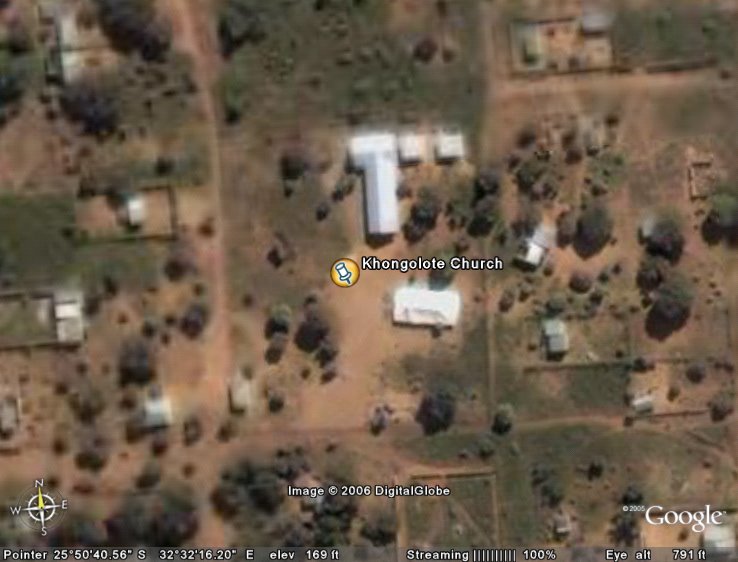
The satellite photo to the left shows the Khongolote property, and provides a flavour of this African suburb. It was taken three years ago, so doesn't include the new church building (to the lower right of the marker pin is the tent that the community had been using as a church building). Pictured above the marker is a preschool attended by over 100 children. I was on the site this morning working with Melvin Kelly (a construction engineer colleague from Northern Ireland) and two Mozambican nationals -- Belarmino and Carlos -- creating a sketch plan for a kitchen that the Mozambicans will build on the site in the coming months, funding permitting.


More Than A Church

This week, I have been working with several Mozambicans -- Raul, Ricardo and Alfredo (shown in the picture) -- on an experimental two-week long business training program for a group of 18 or so Mozambicans who expressed an interest in a pilot training program. (My role has been to encourage and support from alongside the leaders -- there are several good reasons for not standing up and doing the business training myself (aside from my lack of fluency in Portuguese), but I'll write more on the philosophy of sustainability in a future blog entry). It's exciting to me that the church in Khongolote has provided the stage for these two weeks of training.

We've also been conversing with Banco Opportunidade -- the local microcredit lending bank run by Opportunity International -- about the possibility of providing business loans for this group of trainees. Several months ago, my thinking about microcredit lending revolved around originating loans, but the reality is that I am only here for a short time and want to create persistent change. I've realized that I can have a greater impact by partnering with existing organizations and empowering Mozambicans, rather than reinventing the wheel at every turn -- and making mistake after mistake that others have already learned from.

Once these two weeks of experimentation have been completed, Glenn and I will evaluate its successes and failures, and will hopefully have inspired a couple of Mozambicans to start their own businesses in the process.


Homes in Khongolote

Driving to and from Khongolote every morning this week for the training sessions has provided me much time for questioning Raul, who has become my "cultural champion." Raul Manhica is a 28-year-old man who is living in Maputo with his older brother and family. Raul was born in Inhambane, a province just north of Maputo, until his parents were killed when he was just two years old. I wanted to ask more about his parents -- my guess is that they were killed during the country's civil war -- but the topic of conversation shifted to other things.

I asked Raul many questions about the housing in Khongolote as we drove through the village. I learned that the people who live in Khongolote are generally able to own their own homes, which are simple clay brick structures with tin roofs (stereotypically African reed-construction housing is still popular in Mozambique, but not in Khongolote, where there are no swamps for reeds to grow).

A basic starter home in Khongolote costs about $4,500 to build, for which you would get one or two bedrooms, a living area and a kitchen. The brick work would remain uncovered, and the washroom would be out back.

A fancier home, with an indoor washroom and plastered and painted brickwork (similar construction as the Khongolote church pictured above) could cost twice that much.

(Minimum wage in Mozambique was raised this year, to US$57/month for general labourers, and US$40/month for agricultural workers. Of course, many people are not fortunate enough to have jobs in the formal economy.)